
Interior Insulation Without Mold – How Aerogel and Carbon Surface Heating Work Together in Old Buildings
Interior insulation without mold is a central topic for many old building owners. Especially when the facade cannot be altered or external insulation is ruled out for structural, design, or monument protection reasons, interior insulation becomes the decisive solution. At the same time, there is often concern that subsequent interior insulation will trap moisture and later lead to mold.
This is precisely why it's not just about the insulation material, but about the entire wall structure, the surface temperatures, the execution of connections, and the heating strategy. Particularly interesting in this context is the combination of aerogel insulation and carbon surface heating. In existing buildings, it can be a very slim, structurally sound and comfortable solution – provided the construction is professionally planned.
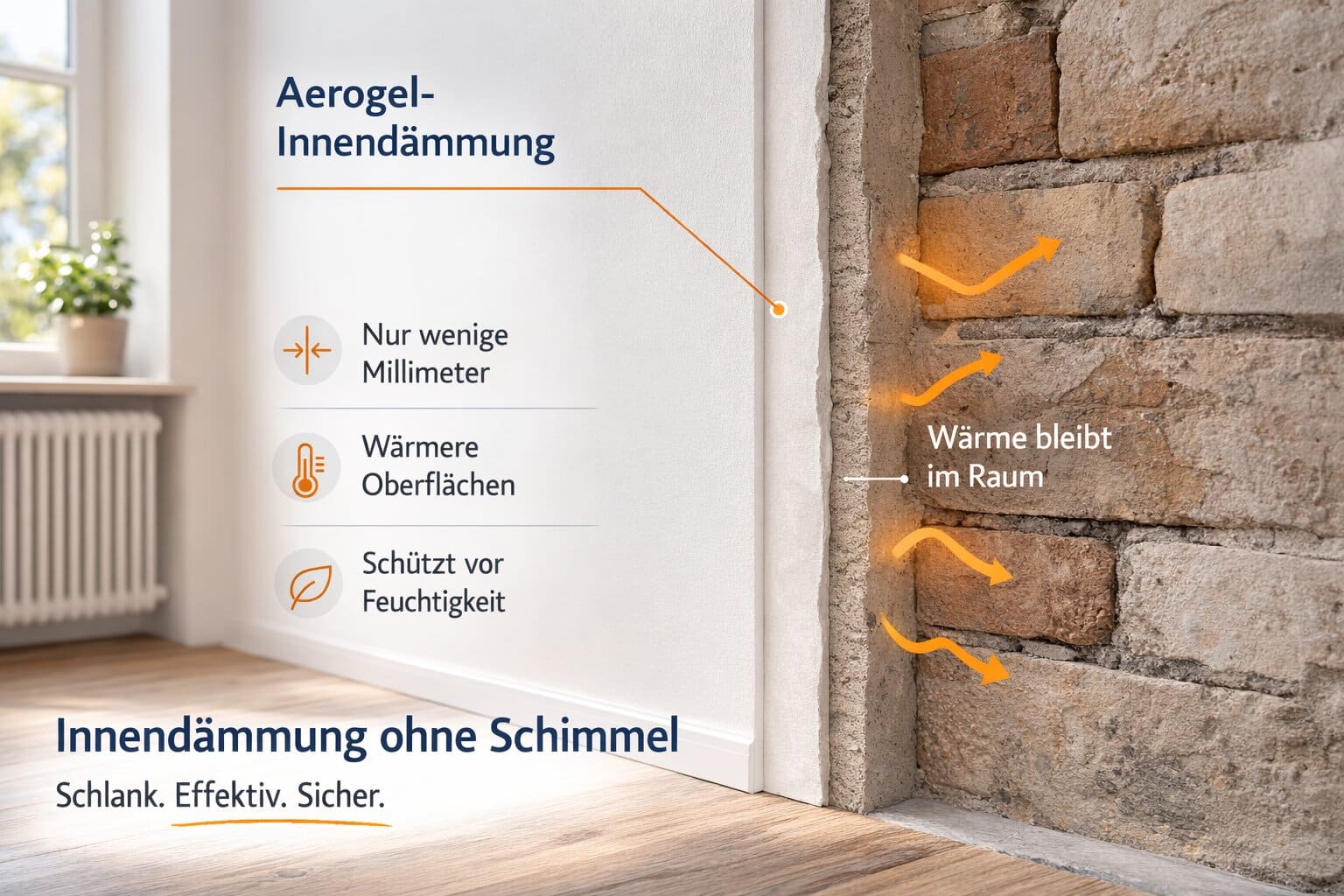
Why Interior Insulation Without Mold is Particularly Sensitive in Old Buildings
Interior insulation changes the temperature distribution within the exterior wall. The inner surface becomes warmer, while the dew point shifts within the component. This creates new requirements for planning and execution. Particularly critical are areas where thermal bridges form or cold surfaces persist – such as window reveals, internal wall connections, ceiling connections, or in the plinth area.
Mold does not simply arise from insulation, but from excessive moisture in combination with excessively cold surfaces. Therefore, internal insulation without mold must always be planned in such a way that surface temperatures are raised, critical connections are properly resolved, and moisture peaks are avoided.
- ✔ warmer surfaces reduce the risk of condensation
- ✔ clean reveal and connection details are crucial
- ✔ heating and insulation must be considered together
- ✔ thin, high-performance insulation materials are often advantageous in old buildings
Interior Insulation Without Mold with Aerogel – Why the Material is So Interesting for Old Buildings
Aerogel insulation materials are particularly interesting for existing buildings because they can achieve a very high insulation effect even with low material thickness. This is an advantage wherever space is limited: at window reveals, in narrow corridors, in historical interiors, or wherever space loss should be kept as minimal as possible.
Compared to thicker insulation structures, aerogel can help to resolve details more cleanly and to better manage geometric weak points. This is precisely what is crucial for internal insulation without mold, because many problems do not arise on the large wall surface, but at transitions and connections.
| Property | Advantage in Old Buildings |
|---|---|
| low build-up height | less room loss, better integration into existing details |
| high insulation performance | higher surface temperatures despite slim construction |
| suitable for sensitive areas | helpful for reveals, connections, and monument-sensitive solutions |
Why Carbon Surface Heating Can Sensibly Complement Interior Insulation Without Mold
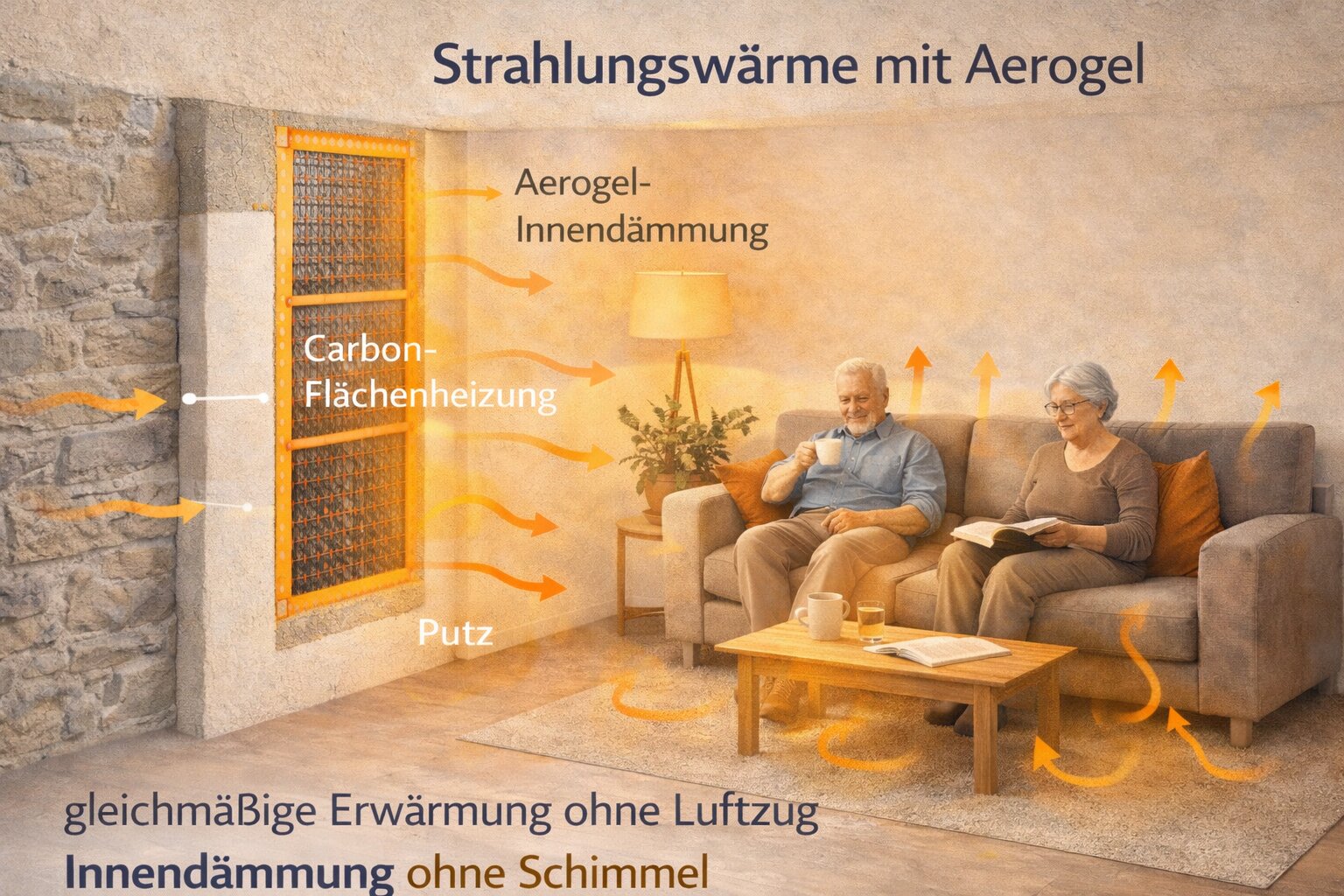
In existing buildings, a carbon surface heating system acts not only as a heating system but also as a tool for improving thermal comfort. Due to the large-area radiant heat, the surface temperatures on the internal wall increase, which positively affects the room climate and can mitigate critical cold zones.
Especially in combination with aerogel insulation, an interesting system solution emerges: The insulation reduces heat loss to the outside, while the surface heating evenly tempers the inner surface. This makes the inside of the wall warmer and more comfortable – a crucial point for interior insulation without mold and for comfortable rooms in old buildings.
Interior Insulation Without Mold and Carbon Surface Heating – The Important Technical Point
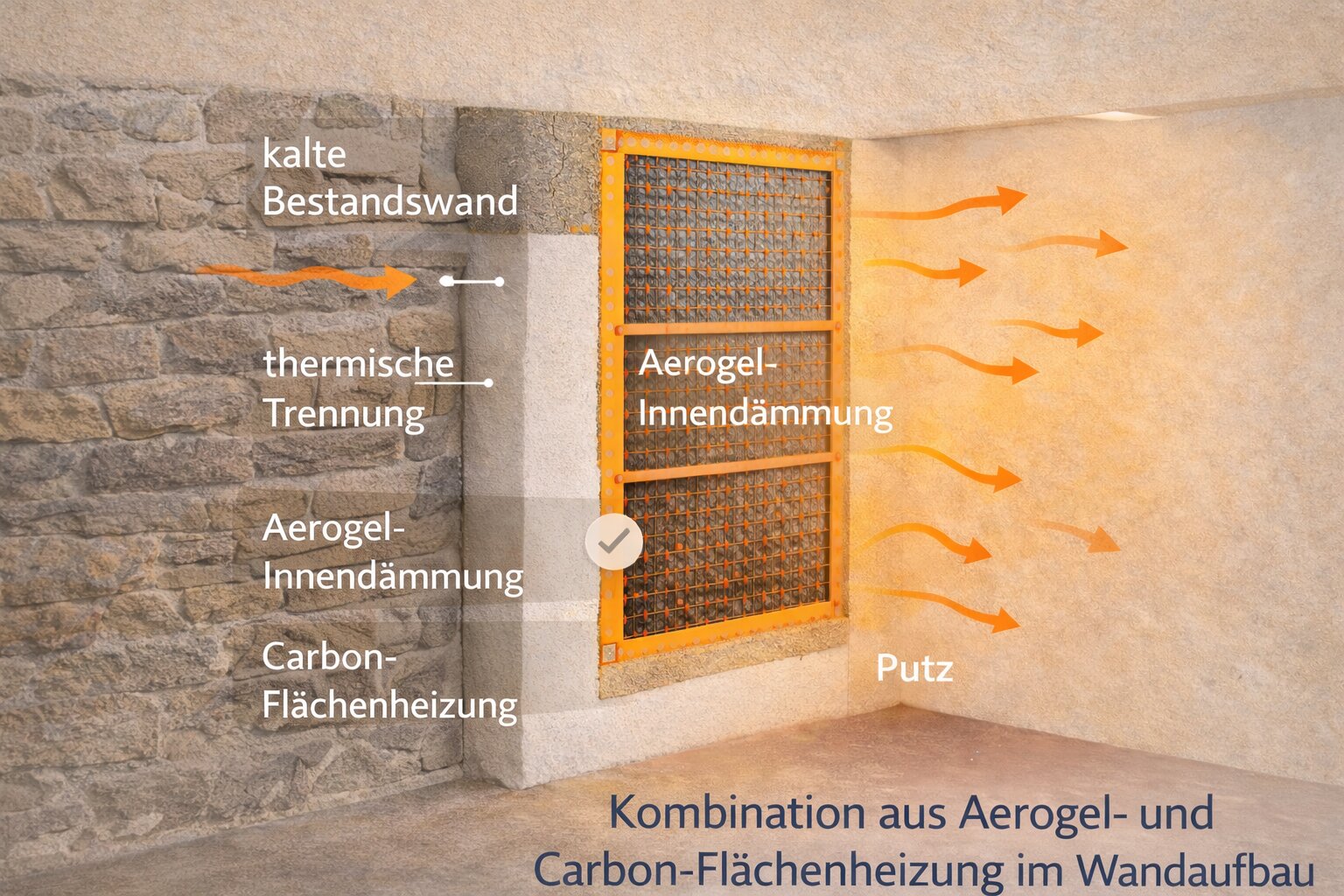
One aspect is particularly important in planning: A carbon surface heating system fundamentally emits heat to both sides. This is precisely why it must be thermally separated within the wall, ceiling, or floor structure. If this thermal separation is not considered, part of the heating energy flows in the wrong direction – i.e., into the substrate, into adjacent building components or into the existing wall – instead of into the room.
In practical terms, this means: Behind the carbon surface heating system, a structurally sound layer sequence must be provided so that the heat is preferentially emitted towards the room. Especially with wall heating in the context of internal insulation, this thermal decoupling is a central planning issue.
- ✔ Carbon surface heating generates pleasant radiant heat
- ✔ Aerogel reduces heat loss with a slim construction
- ✔ thermal separation directs heat into the room
- ✔ combination improves comfort and detail quality in old buildings
Interior Insulation Without Mold: Where Particularly Careful Planning is Required
Even with high-quality materials, execution remains crucial. Particularly sensitive areas are:
- Window reveals
- Ceiling connections
- Internal wall connections
- Plinth and floor connections
- Built-in elements, niches, and historical wall irregularities
It is precisely in these areas that it is often decided whether interior insulation without mold will function long-term. Therefore, planning should not only focus on the large wall surface but especially on the transitions.
A neutral, strong source of information on mold, moisture, and critical interior insulation details is the Mold Guide from the Federal Environment Agency.
This page is part of our guide to Old Building Heating Without Radiators . In it, we explain how insulation, heating systems, and building structure interact in old buildings – for example, in the combination of interior insulation, aerogel and modern surface heating systems.
Conclusion: Interior Insulation Without Mold Only Works as a System Solution
Anyone wishing to insulate internally in an existing building should not just look for an insulation material, but for a functional overall structure. Aerogel insulation offers great advantages where space is limited and critical details need to be resolved cleanly. In combination with a correctly thermally separated carbon surface heating system, this can result in a solution that is convincing both energetically and in terms of building physics.
The decisive factor is not the individual component, but the interaction of wall structure, connection details, surface temperature, and heating strategy. Only then will a sensitive existing building situation become internal insulation without mold that functions permanently.
Questions about Interior Insulation Without Mold?
If you would like to know whether aerogel insulation and carbon surface heating can be sensibly combined in your old building, please send us a short inquiry.
Request Non-Binding ConsultationFAQ: Interior Insulation Without Mold
Is interior insulation without mold really possible in old buildings?
Yes, if the structure is planned cleanly in terms of building physics. Crucial factors are thermal bridges, connections, surface temperatures, and appropriate moisture management.
Why is aerogel interesting for interior insulation without mold?
Aerogel achieves a high insulation effect with low thickness. This is particularly helpful where space is limited and details such as reveals or connections need to be resolved as compactly as possible.
Can carbon surface heating be installed directly on any wall?
Not without planning. Carbon surface heating systems emit heat to both sides and must therefore be thermally separated so that the energy is emitted into the room and not into the substrate.
What is the biggest source of error in interior insulation without mold?
Mostly it's not the large wall surfaces, but the connection details: window reveals, ceiling connections, internal walls, or plinth areas.